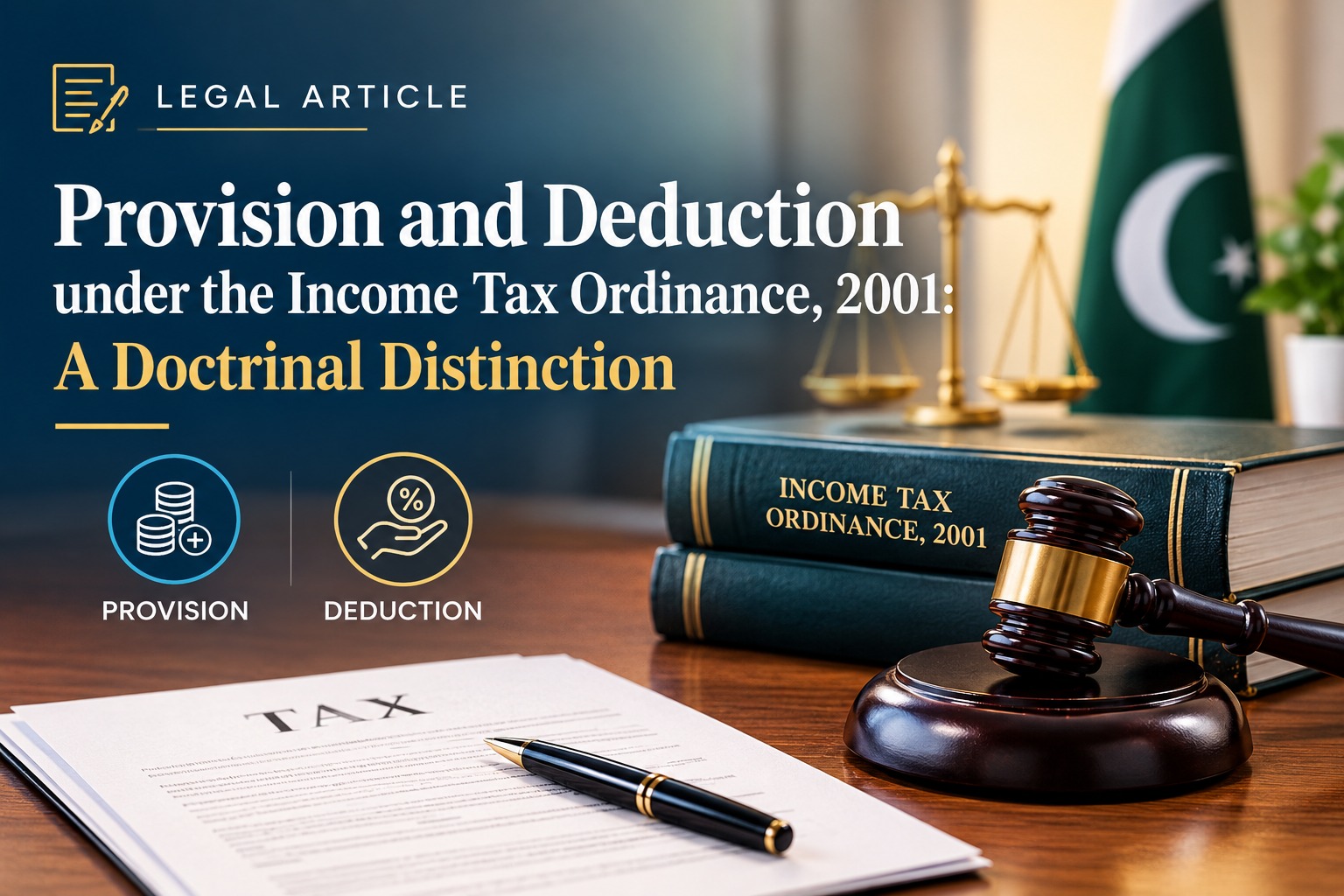
Provision and Deduction under the Income Tax Ordinance, 2001: A Doctrinal Distinction
Saba Saeed Sheikh
Advocate Supreme Court of Pakistan
Chamber of Saba Saeed Sheikh, Advocates and Consultants, Lahore
I. The Problem of Language
In commercial accounts, “provision” and “expense” are often used almost interchangeably. In the Income Tax Ordinance, 2001 (“the Ordinance”), they are not. A deduction is a statutory allowance that reduces income chargeable to tax. A provision, in the accounting sense, is an estimated charge created against profits for a liability that is probable but not yet crystallised. The Ordinance does not treat the two as equivalents. As a rule, a mere provision is added back; a deduction is allowed only when the statute is satisfied.
The confusion is compounded because the word “provision” also appears in the Ordinance in a second, legislative sense — a section, clause or rule. That usage is not the subject of this article. What follows is the fiscal distinction between an accounting provision and a tax deduction.
II. What a Deduction Is
Taxable income is total income reduced by deductible allowances under Part IX of Chapter III. Income under each head is itself the amount derived under that head as reduced by the deductions allowed under that head.
The governing rule for business is section 20(1): subject to the Ordinance, a deduction is allowed for any expenditure incurred in the tax year wholly and exclusively for the purposes of business. Three ideas do the work:
Incurred.
The outgoing must have become a present liability of the taxpayer in the year. Accrual-basis accounting under section 34 permits deduction when the liability is incurred, even if unpaid; cash-basis accounting under section 33 generally waits for payment. Section 73 then prevents double deduction — once on the payable basis, again on the paid basis.
Wholly and exclusively for business.
Personal expenditure is barred by section 21(h). Mixed expenditure is apportioned under section 67.
Not otherwise prohibited.
Section 21 catalogues amounts that, even if booked as expense, are not deductions: tax on profits, certain unpaid withholding, entertainment beyond prescribed limits, contributions to unapproved funds, personal expenditure, and — of particular importance here — any amount carried to a reserve fund or capitalised in any way (section 21(i)).
Deductions also exist outside section 20. Section 15A lists the only deductions against income from property. Section 40 allows, against income from other sources, expenditure paid (not merely provided) in deriving that income, other than capital expenditure. Depreciation, initial allowance and amortisation of intangibles (sections 22–24) are statutory deductions of a different character: they are allowed even though the corresponding accounting charge is added back. Part IX allowances (Zakat, Workers’ Welfare Fund, Workers’ Participation Fund, education) are deducted from total income, not from a head.
A deduction, therefore, is never a matter of bookkeeping courtesy. It is a statutory grant, conditioned by the text.
III. What a Provision Is
In accounting, a provision is a liability of uncertain timing or amount — doubtful debts, warranties, leave encashment, diminution in investments, expected credit loss under IFRS 9, a general contingency reserve. The charge reduces reported profit. That does not, of itself, reduce taxable income.
The reason is conceptual. A provision is an estimate of a future or contingent outgoing. Until the liability is incurred (or, in the special case of bad debts, written off on the conditions in section 29), there is no “expenditure incurred” within section 20. Transfer to a reserve is expressly disallowed by section 21(i). Courts have been consistent that a mere provision for doubtful debts is not a bad-debt deduction. Write-off in the accounts, prior inclusion in taxable business income (or lending by a financial institution), and reasonable grounds that the debt is irrecoverable are all required.
The same logic applies to provision for gratuity, warranties, or general contingencies. Contribution to an approved gratuity fund may be deductible, subject to section 21(e) and 21(ea). A mere book provision for unfunded gratuity is not a contribution to an approved fund. An unapproved fund contribution is positively disallowed.
IV. The Line Drawn by the Ordinance
Comparative Table
| Aspect | Deduction | Provision (accounting) |
|---|---|---|
| Legal character | Statutory allowance reducing chargeable income | Estimate booked against profits |
| Source of right | Sections 20, 15A, 22–31, 40, Part IX, Schedules | Accounting standards / prudence; not a tax right |
| Timing | Year in which expenditure is incurred (or paid, if the section so requires) | Year in which management estimates the charge |
| Certainty | Present liability, or statutory fiction (depreciation, specified reserves) | Contingent or unquantified |
| Default tax treatment | Allowed if conditions met | Added back unless a specific enabling provision applies |
| Evidence | Records of the transaction or circumstances (section 174) | Board minute or accounting policy is not enough |
| Reversal / recovery | Recouped expenditure is income (s. 70); recovered bad debt is income (s. 29(3)) | Reversal of a disallowed provision is generally not taxed again; reversal of an allowed provision is taxed |
The operational test is simple: Has the Ordinance allowed this amount as a deduction, or has the taxpayer merely provided for it?
V. Bad Debts: The Classic Collision
Section 29 is the provision that most often forces the distinction into the open. A deduction for a bad debt is allowed only if:
- the debt was previously included in business income chargeable to tax, or is money lent by a financial institution in deriving such income;
- the debt or part of it is written off in the accounts in the tax year; and
- there are reasonable grounds for believing it is irrecoverable.
The amount allowed cannot exceed the amount written off. Subsequent recovery is brought to tax.
Two consequences follow. First, a general or specific provision for doubtful debts, however prudent under IFRS, is not a write-off. Practitioners therefore add back the year’s provision and deduct only amounts actually written off (net of any write-off against an opening provision that was itself never allowed). Second, “reasonable grounds” is a taxpayer’s burden, but once a rational commercial basis is shown, the Department is not to second-guess the write-off. That is the line drawn in Commissioner of Income-Tax v. National Bank of Pakistan, Karachi (PLD 1976 Karachi 1025) and affirmed by the Supreme Court in Commissioner Inland Revenue (Zone-I), Karachi v. Messrs Faysal Bank Limited (2020 SCMR 1045).
A write-off of an advance that was never taken to income may still be examined as a trading loss under section 20 on principles of commercial expediency, but that is a different and narrower route. It does not convert every provision into a deduction.
VI. Statutory Exceptions: Where a “Provision” Is a Deduction
The Ordinance is not hostile to every provision. It is hostile to undisciplined provisions. Where Parliament wishes to allow a provision, it says so.
Section 29A — Consumer Loans
A non-banking finance company or the House Building Finance Corporation may deduct, not exceeding three per cent of income arising from consumer loans, a reserve to offset bad debts on those loans. Excess bad debts are carried against future reserve. This is a true statutory provision-as-deduction, limited in person, purpose and quantum.
Section 30 — Non-Performing Debts of Banks and DFIs
Profit on non-performing debts of a banking company or development finance institution is dealt with on a special basis, distinct from the ordinary accrual rule.
Section 31 — Participatory Reserve
Transfer to a participatory reserve is allowed on the conditions there stated.
Seventh Schedule — Banking Companies
This is the most elaborate exception. Subject to the current text of Rule 1:
- provisions for advances and off-balance-sheet items are allowable up to 1% of total advances (5% for consumer and SME advances as defined in SBP prudential regulations), if an external auditor certifies that the provisions follow those regulations;
- excess provisioning may be carried forward; if actual provisioning is below the cap, actual provisioning is allowed;
- bad debts classified as substandard or doubtful, and IFRS 9 expected credit loss on stages I–III, are not allowable as expense;
- only bad debts classified as “loss” on non-performing assets under SBP prudential regulations are allowable as expense; and
- reversals of provisions that were allowed are taxable.
The Schedule thus converts a regulated provision into a deduction, and simultaneously shuts the door on unregulated or early-stage ECL provisioning. A bank that books IFRS 9 impairment in full still adds back everything that the Seventh Schedule does not expressly allow.
Approved Funds (Sixth Schedule)
Contributions to a recognised provident fund, approved pension fund, approved superannuation fund or approved gratuity fund are taken outside the section 21(e) prohibition. Even then, section 21(ea) limits excess contributions. A book provision that never leaves the company is not a “contribution.” The Supreme Court has confirmed that contributions to an unapproved gratuity fund are not deductible under section 21(e).
Insurance (Fourth Schedule)
Reserves and provisions are allowed only within the limits of the Insurance Ordinance, 2000, unless the Securities and Exchange Commission of Pakistan permits the excess and the amount is incurred in deriving chargeable income. Amounts taken to reserve for depreciation of investments are not deductions.
These exceptions prove the rule. A provision is deductible only when a specific enabling text exists, and only within that text.
VII. Accrual Is Not a Licence to Provide
Taxpayers sometimes argue that, because they are on the accrual basis (section 34), every year-end provision is “incurred.” That overreads the section.
Section 34 determines when an amount that is otherwise deductible is brought to account. It does not enlarge what is deductible. A contingent warranty provision, a general litigation reserve, or an IFRS 9 lifetime-loss estimate on performing loans is not a present, quantifiable liability of the kind section 20 contemplates. Depreciation in the accounts is the clearest illustration: the accounting charge is real, yet tax depreciation is a separate statutory computation, and the book charge is added back.
The Commissioner may also disallow or reduce a claimed deduction under section 174 if the taxpayer cannot produce a receipt or other evidence of the transaction or circumstances giving rise to the claim. A provision supported only by a journal voucher and a board estimate will rarely survive that inquiry.
VIII. Worked Contrast
Example A — Trade Receivable
Sales of Rs. 10 million were offered to tax in Year 1. In Year 2 the company creates a 10% provision for doubtful debts (Rs. 1 million) and writes off Rs. 200,000 against a named debtor who has absconded.
Tax result: Rs. 1 million provision added back. Rs. 200,000 allowed under section 29 if reasonable grounds are documented. If Rs. 50,000 is later recovered, section 29(3) brings it to tax.
Example B — Unfunded Gratuity
The company books a provision of Rs. 5 million for staff gratuity under IAS 19. No approved fund exists.
Tax result: Added back. Section 21(e) would also bar a contribution to an unapproved fund. Payment of actual gratuity to retiring employees in the year may be examined as an incurred business expenditure, distinct from the provision.
Example C — Bank under the Seventh Schedule
A bank books IFRS 9 expected credit loss of Rs. 800 million. SBP “loss” classification write-offs are Rs. 120 million. General provision within the 1% cap, auditor-certified, is Rs. 200 million.
Tax result: Rs. 200 million (cap) plus Rs. 120 million (loss classification) are the deductions the Schedule contemplates. The balance of the ECL charge is added back. Subsequent reversal of the allowed provision is income.
IX. Practical Consequences for Assessment and Appeal
- Add-back is the starting point. Every provision appearing in the profit and loss account should be identified and tested against an enabling section or Schedule. What cannot be matched is added back.
- Write-off files win cases; provision notes do not. For section 29, the record must show the account written off, the history of inclusion in income, recovery efforts, and the commercial basis for treating the debt as irrecoverable.
- Do not conflate accounting policy with tax policy. IFRS 9, IAS 19 and prudence are relevant to whether the accounts are true and fair. They are not a charging or relieving provision of the Ordinance.
- Watch reversals. If a provision was never allowed, its later write-back should not be taxed again. If it was allowed (Seventh Schedule, section 29A, or a section 29 write-off later recovered), the reversal or recovery is income.
- Approved-fund discipline. Gratuity, pension and provident claims turn on approval and on the section 21(ea) cap, not on the actuarial provision in the notes to the accounts.
- Banks and insurers live in their Schedules. General principles in sections 20 and 29 are displaced or modified. Argument on the wrong text is wasted.
X. Conclusion
A deduction under the Income Tax Ordinance, 2001 is a creature of statute. A provision is a creature of accounts. The Ordinance allows the first when expenditure has been incurred wholly and exclusively for business, or when a special provision — section 29 write-off, section 29A reserve, Seventh Schedule provisioning, approved-fund contribution — expressly says so. It refuses the second when the amount is only estimated, contingent, or parked in a reserve.
The distinction is not academic. It determines whether a charge that has already reduced book profit will also reduce the tax base. The correct question in every assessment is not whether the provision is prudent, but whether the Ordinance has converted it into a deduction. Where it has not, the amount remains what it always was: a provision, and nothing more.
This article is an exposition of the statutory scheme and leading principles. It is not an opinion on any pending assessment. The text of the Ordinance as amended from time to time, and the facts of each case, govern.
Principal authorities: Income Tax Ordinance, 2001, ss. 9, 11, 15A, 20, 21, 22–24, 29, 29A, 30, 31, 32–34, 40, 60–60D, 67, 70, 73, 174; Fourth, Sixth and Seventh Schedules; Commissioner of Income-Tax v. National Bank of Pakistan, Karachi, PLD 1976 Karachi 1025; CIR v. Faysal Bank Ltd., 2020 SCMR 1045.