
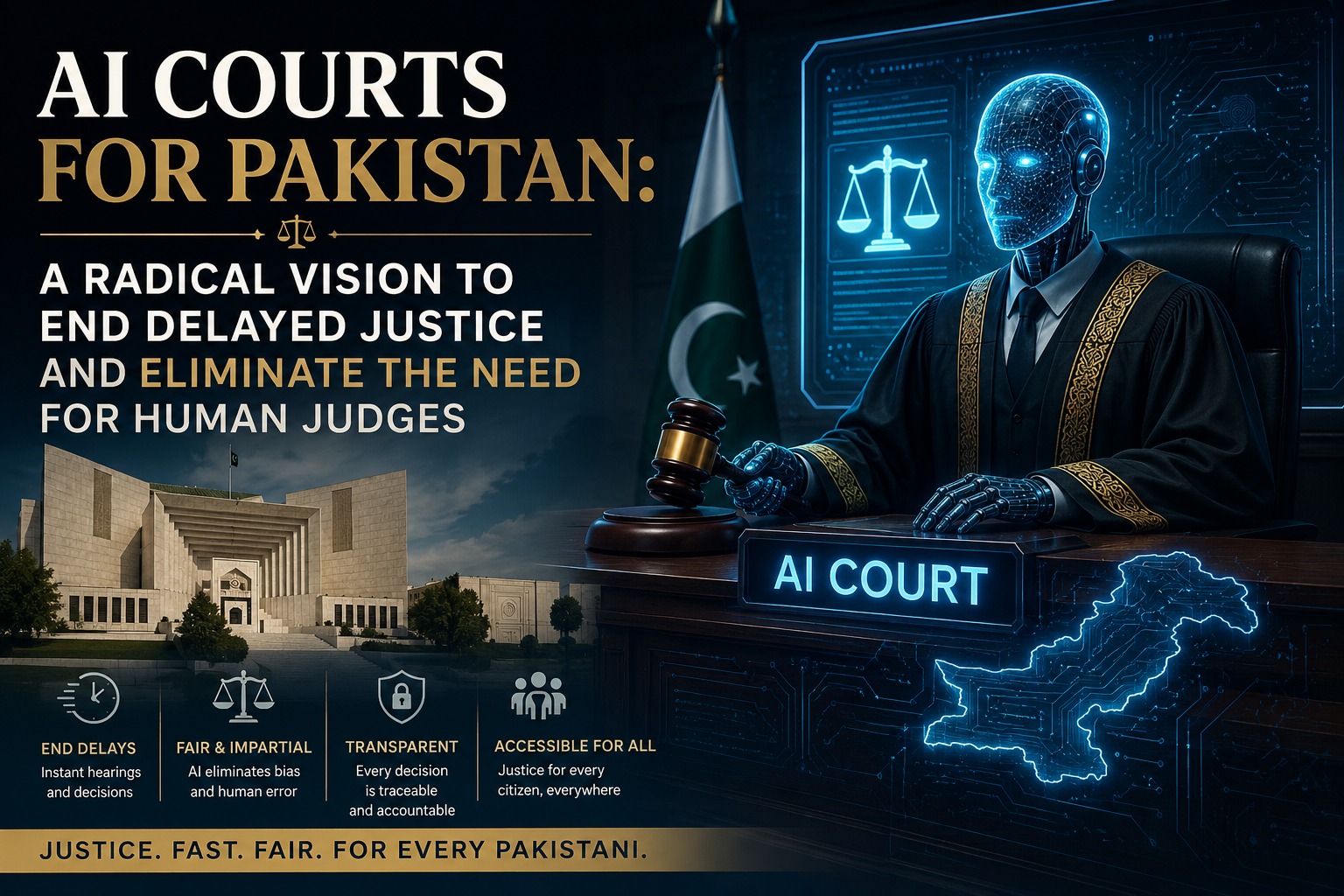
AI Courts for Pakistan: A Radical Vision to End Delayed Justice and Eliminate the Need for Human Judges
Pakistan’s justice system stands at a breaking point. For millions of citizens, the promise of “justice” enshrined in the Constitution remains an empty slogan. Over 2.2 million cases are pending across the country, with nearly 1.86 million clogging district courts alone. The Supreme Court has seen modest reductions in its backlog recently, but the overall crisis persists: cases drag on for years—sometimes decades—while litigants suffer. One judge serves roughly 62,000 citizens. Courtrooms are plagued by endless adjournments, political interference, bribery allegations, and outdated manual procedures. The poor and marginalized bear the heaviest burden: for them, justice delayed is not merely denied—it is unaffordable.
Article 10-A of the Constitution guarantees every citizen the right to a fair trial and due process. Yet the current human-led system routinely violates this fundamental right. Judges, however well-intentioned, are human: susceptible to bias, fatigue, political pressure, and corruption. Lawyers exploit loopholes, files disappear, and powerful interests tilt the scales. The result is a system that erodes public trust and weakens the rule of law. Incremental reforms—more judges, better case management, e-courts—have been tried, but they treat symptoms, not the disease.
It is time for a bolder, transformative idea: Pakistan should convert its courts into AI Courts. Human judges are no longer necessary. Instead, develop or evolve a single, sovereign AI judicial system—a comprehensive software platform trained on the entire body of Pakistani law: the Constitution of 1973, all statutes, the Islamic principles embodied in the Objectives Resolution, Supreme Court and High Court precedents, and Sharia jurisprudence where applicable. This AI would function as an impartial, tireless, incorruptible adjudicator.
How AI Courts Would Work
1. Digital Filing and Input: Every case begins with a standardized, AI-assisted digital filing. Litigants or their lawyers upload facts, evidence, witness statements, and legal propositions in plain language or structured format. The system uses natural language processing to understand arguments in Urdu or English.
2. Instant Analysis: The AI instantly cross-references the input against the full corpus of law, precedents, and constitutional principles. It identifies relevant statutes, analogous cases, and applicable legal tests. No more months of research or selective citation of judgments.
3. Reasoned Judgment: Within hours—or minutes for straightforward matters—the AI delivers a complete, written judgment: findings of fact, application of law, reasoning, and clear orders. The output is transparent and explainable; every step of the AI’s logic is traceable and auditable by any citizen.
4. No Human Judges Required: Lower and trial courts are fully automated. For appeals, higher-tier AI instances (with enhanced reasoning capabilities) review the case. Human oversight could be retained only at the Supreme Court level for rare constitutional questions of first impression, or phased out entirely once public confidence is established.
This is not science fiction. Estonia has experimented with AI for small-claims disputes. China deploys AI-assisted sentencing and case analysis. The UAE and Singapore run “smart courts” with predictive analytics. Pakistan has already taken baby steps: one sessions judge used GPT-4 to draft a judgment in 2023, the Lahore High Court has piloted AI for case scheduling, and the Supreme Court leadership has publicly called for ethical AI integration. We simply need to go further and faster—building a home-grown, sovereign Pakistani AI Justice System.
The Transformative Benefits
– Speed: The backlog could be cleared in months rather than generations. A nation of 240+ million people could resolve disputes in real time.
– Impartiality and Anti-Corruption: No bribes, no political pressure, no “phone calls from above.” The algorithm treats every citizen equally, applying the law uniformly.
– Consistency: Identical facts yield identical outcomes—ending the lottery of which judge hears your case.
– Accessibility and Affordability: Digital filing from a smartphone, AI-generated plain-language summaries, and nominal or zero fees for low-income litigants would democratize justice.
– Transparency and Accountability: Every judgment is publicly searchable and explainable. Citizens could query the AI directly for legal advice, reducing frivolous litigation.
– Scalability: The system handles millions of cases simultaneously without needing 15,000 more judges or new court buildings.
Addressing Legitimate Concerns
Critics will raise valid questions. Could AI be biased if trained on flawed historical data? Yes—but this is solvable through rigorous auditing, continuous retraining on verified Pakistani case law, and mandatory “algorithmic impact assessments” by an independent Judicial AI Oversight Commission. Privacy? Strong data-protection laws and encryption, aligned with Pakistan’s emerging digital framework, would safeguard sensitive information.
What about nuanced human judgment or mercy? The AI can be programmed with equitable principles drawn from Islamic jurisprudence (adl and ihsan) and constitutional values. For complex or precedent-setting cases, a hybrid model with limited human review could serve as a transitional safeguard. Constitutional challenges under Article 10-A can be met by ensuring the AI’s processes are fairer, faster, and more transparent than today’s system.
A Practical Path Forward
Pakistan does not need to leap blindly. Begin with pilot AI Courts in select districts for civil, family, and minor criminal matters (small claims, traffic, recovery suits). Build on existing e-court infrastructure and the Law and Justice Commission of Pakistan. Partner with local tech talent—Pakistan already produces world-class AI engineers—and international ethical AI experts. Enact an “AI Judiciary Act” to govern transparency, bias mitigation, and public audit rights. Train lawyers and judges in the new system rather than replace them overnight.
The era of human judges presiding over crumbling, overburdened courts has served its time. Pakistan’s justice system is crying out for innovation. Converting courts into AI Courts is not just technologically feasible—it is morally imperative. It offers the chance to deliver on the constitutional promise of justice for all, swiftly, fairly, and without fear or favor.
The question is no longer whether Pakistan can afford to keep the current system. The real question is: can we afford not to embrace AI Courts? The time to build the future of justice is now.