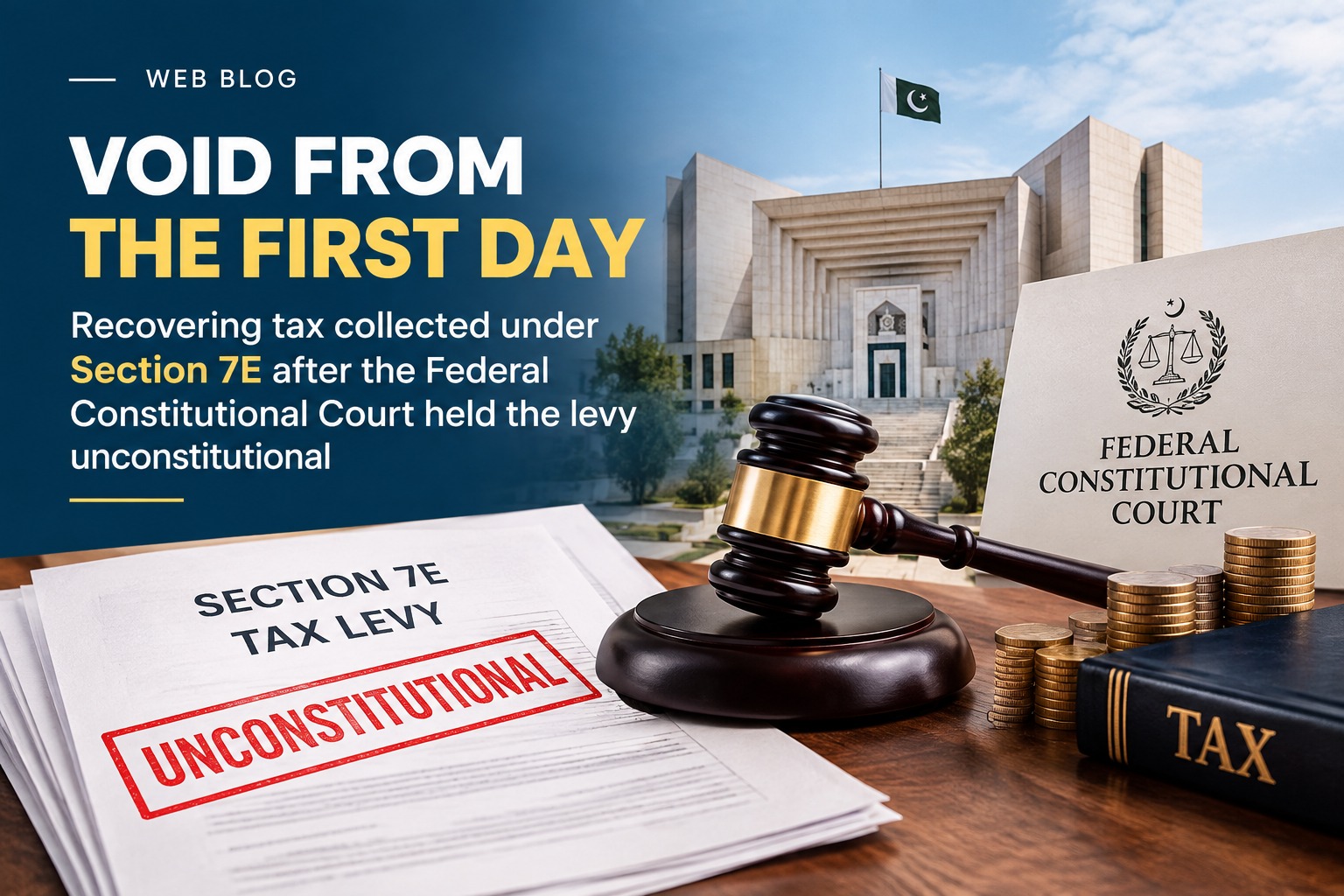
VOID FROM THE FIRST DAY
Recovering tax collected under Section 7E after the Federal Constitutional Court held the levy unconstitutional
Federal Constitutional Court · Short order 7 May 2026 · Detailed reasons June 2026 · FBR letter 23 September 2026
I. The levy that has fallen
Section 7E was inserted into the Income Tax Ordinance, 2001 by the Finance Act, 2022. A resident person was treated as having derived income equal to five per cent of the fair market value of immovable capital assets held in Pakistan on the last day of the tax year. That figure was taxed at twenty per cent, producing an effective annual charge of one per cent of FBR value, subject to a twenty-five million rupee aggregate threshold and listed exclusions (one capital asset, self-occupied business premises on the Active Taxpayers’ List, agricultural land excluding a farmhouse, specified allotments, property already charged to tax, the first year of acquisition where tax under section 236K had been paid, and assets of governments and certain registered developers). Ownership on 30 June was enough. Receipt of income was irrelevant. Compliance was further entrenched by the administrative practice of demanding a section 7E certificate before mutation or transfer.
The provision was challenged before every High Court. The Peshawar High Court and the High Court of Balochistan struck it down. The Lahore High Court and the High Court of Sindh sustained it in varying degrees. The Islamabad High Court read parts of it down. Petitions for leave were filed before the Supreme Court of Pakistan. After the Twenty-Seventh Constitutional Amendment, pending constitutional matters were transferred to the Federal Constitutional Court under Article 175E(5). For the taxpayer the juridical consequence is the same: a binding pronouncement that the charging section never validly existed.
II. The judgment
On 7 May 2026 a two-member Bench comprising Chief Justice Amin-ud-Din Khan and Justice Ali Baqar Najafi, in C.P.L.A. No. 1442-K of 2022 (Sher Muhammad Mughari v. Federation of Pakistan through Secretary Finance and others) and hundreds of connected matters, announced the following short order:
Having heard the learned counsel for the parties at considerable length and upon due deliberation, we are persuaded to hold that Section 7E of the Income Tax Ordinance, 2001, is ultra vires the Constitution, and is accordingly struck down, being void ab initio. For the reasons to be recorded separately, all the civil petitions filed by the taxpayers against the judgments of the High Court of Sindh and the Lahore High Court are converted into appeals and allowed while civil petitions filed by the FBR/C.I.R against the judgments of the Peshawar High Court and the High Court of Balochistan are dismissed. … Consequently, all actions, proceedings, and notices initiated or taken by the FBR/C.I.R under Section 7E are declared to be without lawful authority and are hereby set aside.
Detailed reasons of some ninety-two pages followed in mid-June 2026. Four holdings control the refund analysis. First, in pith and substance section 7E is a tax on the capital value of immovable property; the characterisation as “deemed income” is illusory and does not satisfy any accepted definition of income in section 2(29). Second, after the Eighteenth Amendment a tax on the capital value of immovable property does not fall within Entry 47 of the Federal Legislative List. Parliament cannot, by legal fiction, convert a provincial property tax into a federal income tax. Third, the levy is confiscatory and trenches upon Articles 23 and 24, because a holder of a non-income-producing asset may be compelled to dispose of the asset in order to pay the annual charge. Fourth, the exemption design treats unequals as equals and fails Article 25. The respondents were restrained from giving the provision any further effect.
III. Why the tax is refundable
A provision declared void ab initio is treated as if it had never been enacted. There is, from inception, no head of income and no rate at which the so-called deemed income could have been charged. Amounts paid under that head are not “tax properly chargeable” within section 170(1). Notices, amendment orders, best-judgment assessments, recoveries under sections 138 and 140, and the practice of withholding mutation pending a 7E certificate all lose their parent provision. Unpaid demands cannot be enforced. Paid demands cannot be retained. Self-assessment under section 120 does not cure the defect: a return assesses tax chargeable under the Ordinance, and a taxpayer’s signature cannot confer legislative competence that the Constitution withheld from Parliament.
The class of claimants is wide because the section was struck down entirely rather than read down. It includes resident persons who declared the levy in a return; persons from whom it was recovered by amendment or attachment; persons who paid to obtain a mutation certificate; and legal representatives or successors of a person who paid. The years in play are Tax Years 2022 to 2025 and any later year in which the charge was applied before the judgment. The measure of the refund is the tax paid or recovered under section 7E together with default surcharge or penalty computed solely on that levy. Actual rental income under section 15 and capital gains under section 37 are independent heads and are not refunded merely because the same property was also subjected to section 7E.
IV. The statutory route
Revision of the return — section 114(6).
A person who has furnished a return and discovers an omission or wrong statement may file a revised return. After the judgment, a 7E declaration is a wrong statement. Written and signed reasons are required. After sixty days from the original filing, written approval of the Commissioner is required under clause (ba). Section 122(3) treats the revised return as an amended assessment of the taxable income and tax payable as set out in it. That is the cleanest method of deleting the void computation from the record.
Refund — section 170.
A taxpayer who has paid tax in excess of the amount properly chargeable may apply to the Commissioner in the prescribed form, verified in the prescribed manner, within three years of the later of the assessment date or the payment date. For a section 120 return, the return is the assessment on the date it is furnished. Under section 170(3) the Commissioner first applies the excess against other tax due under the Ordinance, then against other outstanding liabilities, and refunds only the remainder. Under section 170(4) a speaking order must be served within sixty days after an opportunity of being heard. Appeal lies under section 170(5) against the order or against silence.
Giving effect and rectification — sections 124 and 221.
Where a demand order already sits on the system, section 124 requires the Commissioner to give effect to the Court’s command. Section 221 reaches a mistake apparent from the record, which a void charge now is. These applications prevent automated recovery while the refund is processed.
Compensation for delay — section 171.
If a refund due is not paid within three months of becoming due, compensation runs at KIBOR plus 0.5 per cent per annum. For parties to the connected petitions there is a respectable argument that the refund became due on receipt of the short order of 7 May 2026. For other taxpayers the safer view is that it becomes due when the revised assessment or the section 170 order crystallises the amount. The point should be taken, without being overstated.
Condonation — section 214A.
The Board may condone statutory time limits. Any application close to or past the three-year mark under section 170(2) should carry a formal condonation request, grounded on the date of the judgment and on the Board’s own four-month silence after it.
V. The Board’s letter of 23 September 2026
For more than four months after the short order the Board issued no public circular prescribing a form or forum. After correspondence by the Public Interest Litigation Committee of the Lahore Tax Bar Association, the Board on 23 September 2026 addressed all Chief Commissioners Inland Revenue of the Large Taxpayer Offices, Corporate Tax Offices and Regional Tax Offices. Two directions are operative. Requests for revision of returns filed in the light of the Federal Constitutional Court’s order “shall not be rejected.” Where revision produces a refund, the refund application “shall also be processed expeditiously, in accordance with the applicable law and procedure.”
The letter is confined to the single agenda of section 7E. It is not a general relaxation of section 114(6), and it is not a Super Tax letter under section 4C. Revisions should therefore be confined, so far as possible, to excision of the 7E computation. A revision that also seeks to disturb other heads of income remains exposed to the ordinary conditions of section 114(6), including the requirement that declared taxable income is not less than income already determined by an order under the specified sections. After 23 September 2026, a Commissioner who refuses a 7E-only revision acts contrary both to the Court and to the Board.
VI. Procedure to be followed
- Assemble the record year by year. Extract from IRIS the original return, any revised return, the 7E computation, payment challans, notices or orders under sections 121, 122, 138 or 140, any 7E transfer certificate, and bank evidence of recovery.
- Quantify the claim. Prepare a working sheet showing, for each year, the fair market value adopted, deemed income declared, tax paid under section 7E, associated surcharge or penalty, date and mode of payment, and nothing else.
- Seek approval to revise where the sixty-day window has closed. The application should recite the short order of 7 May 2026, the detailed reasons, the Board’s letter of 23 September 2026, and the precise correction sought — deletion of the section 7E line only.
- File the revised return on IRIS. Attach signed written reasons and copies of the two authorities. Where accounts were affected only by the 7E line, request waiver of revised audited accounts. Do not reduce other declared income.
- File the section 170 application the same week. Do not wait for a further speaking order on the revised return. Section 122(3) already treats that return as an amended assessment. Ask, in the alternative, for adjustment against admitted current liability if cash refund will be delayed.
- If a demand remains live, move under sections 124 and 221. A parallel giving-effect and rectification request keeps recovery off the system while the refund is processed.
- Diary the statutory clocks. If no refund order is served within sixty days, appeal under section 170(5)(b) read with section 127. If a determined refund is not paid within three months of becoming due, claim section 171 compensation in writing.
- Escalate on a defined path. Write first to the Chief Commissioner enclosing the Board’s own letter. Thereafter consider a complaint to the Federal Tax Ombudsman for maladministration in the shape of failure to give effect to a binding judgment and a binding departmental direction. A writ is the last instrument, reserved for the officer who declines to recognise the judgment at all or who continues recovery of a demand the Court has set aside.
VII. Recurring difficulties
Limitation.
Section 170(2) runs three years from the later of the assessment date and the payment date. Tax Year 2022 is the year most exposed. Two answers exist. A revised return treated as an amended assessment under section 122(3) supplies a fresh assessment date. Separately, it is strongly arguable that limitation cannot start before 7 May 2026, when collection was first authoritatively pronounced to have been without authority. Money taken under a void statute is not converted into a time-barred windfall for the State merely because the taxpayer lived under the statute while it was still on the book. File promptly, and file a condonation request wherever the date is close.
Paid after amendment or attachment.
Revision of the return is useful but not sufficient. The demand order must be rewritten under section 124 or 221, and the refund application must annex the recovery challan. If an appeal against the amendment is pending, a miscellaneous application should place the Federal Constitutional Court order on the record and seek deletion of the addition. There is no advantage in litigating a void charge on merits.
Stayed and never paid.
No refund arises. Have the demand cancelled and the stay discharged as infructuous so it does not remain on the recovery register and obstruct a later transfer or an unrelated refund.
Paid to unlock a mutation.
A 7E challan deposited to satisfy a registration office is still a payment of tax and is recoverable by the same route. Write separately to the registration authority that a 7E certificate is no longer a lawful precondition of transfer. That administrative hangover will otherwise outlive the statute.
What the judgment does not do.
It does not erase actual rental income or capital gains. It does not decide Super Tax under section 4C, which the Court treated on a different footing and which the Board’s letter deliberately does not cover. It does not authorise a revision that smuggles in other reductions of income. And it does not post an automatic credit on IRIS. Until the revised return and the refund application are filed, the old computation remains.
VIII. Documents and remedies
Annex to the revision and to the section 170 application: the short order of 7 May 2026 and the relevant pages of the detailed reasons; the Board’s letter of 23 September 2026; original and revised computations with the 7E line isolated; computerised payment receipts; notices, assessment orders, recovery orders and 7E certificates if any; signed reasons for revision and the application for approval under section 114(6)(ba); a signed year-wise working sheet; and, where adjustment is sought, identification of the code, tax year and liability against which adjustment is requested.
If the refund is refused or ignored, the statutory path is an appeal under section 170(5) read with section 127 within thirty days of service, or upon deemed failure; a further appeal to the Appellate Tribunal under section 131; and a reference to the High Court under section 133 on the short question whether tax collected under a provision declared void ab initio is tax “properly chargeable.” A complaint to the Federal Tax Ombudsman lies for maladministration consisting of failure to implement a binding judgment and a binding Board direction. Ordinary processing delay is better taken there, or through the statutory appeal, than to the writ Court in the first instance.
IX. Working checklist
List every tax year in which section 7E was declared, assessed or recovered. Confirm that the amount claimed is only the 7E tax and associated surcharge or penalty. Compute the section 170(2) limitation date for each year and file a condonation request where the date is close. Apply for approval to revise, then file the revised return confined to the 7E excision. File the section 170 application the same week, with a request in the alternative for adjustment. Move under sections 124 and 221 if a demand order remains live. Notify the registration authority that a 7E certificate is no longer required. Diary sixty days for the refund order and three months for section 171 compensation. If there is silence or refusal, appeal, complain to the Federal Tax Ombudsman, and only then consider a writ.
X. Conclusion
The Federal Constitutional Court did not discontinue section 7E for the future. It held that the provision was never law. A tax collected under a provision that was never law is money the Federation was not entitled to receive and is not entitled to keep. The Ordinance already supplies the machinery: revision under section 114(6), statutory effect under section 122(3), refund under section 170, giving-effect and rectification under sections 124 and 221, and compensation under section 171. The Board has now instructed every Chief Commissioner that 7E revisions are not to be rejected and that the resulting refund applications are to be processed expeditiously.
Taxpayers who wait for an automated credit will wait in vain. Taxpayers who file a clean, year-wise, well-documented revision and section 170 application, confined to the void levy, and who enforce the sixty-day and three-month clocks, stand in the position the Constitution already gives them. The window for Tax Year 2022, in particular, should not be allowed to close by inattention. The proper stance of the Department after a judgment of this character is not resistance dressed as procedure. It is restitution.
Note
Authorities: short order dated 7 May 2026 and detailed reasons (June 2026) of the Federal Constitutional Court in C.P.L.A. No. 1442-K of 2022, Sher Muhammad Mughari v. Federation of Pakistan and connected matters; sections 114(6), 120, 122(3), 124, 170, 171, 214A and 221 of the Income Tax Ordinance, 2001; FBR letter dated 23 September 2026 to Chief Commissioners Inland Revenue (LTOs, CTOs and RTOs). This is an exposition of the law at the end of September 2026. Limitation, pending appeals and quantification must be examined on the record of each case.