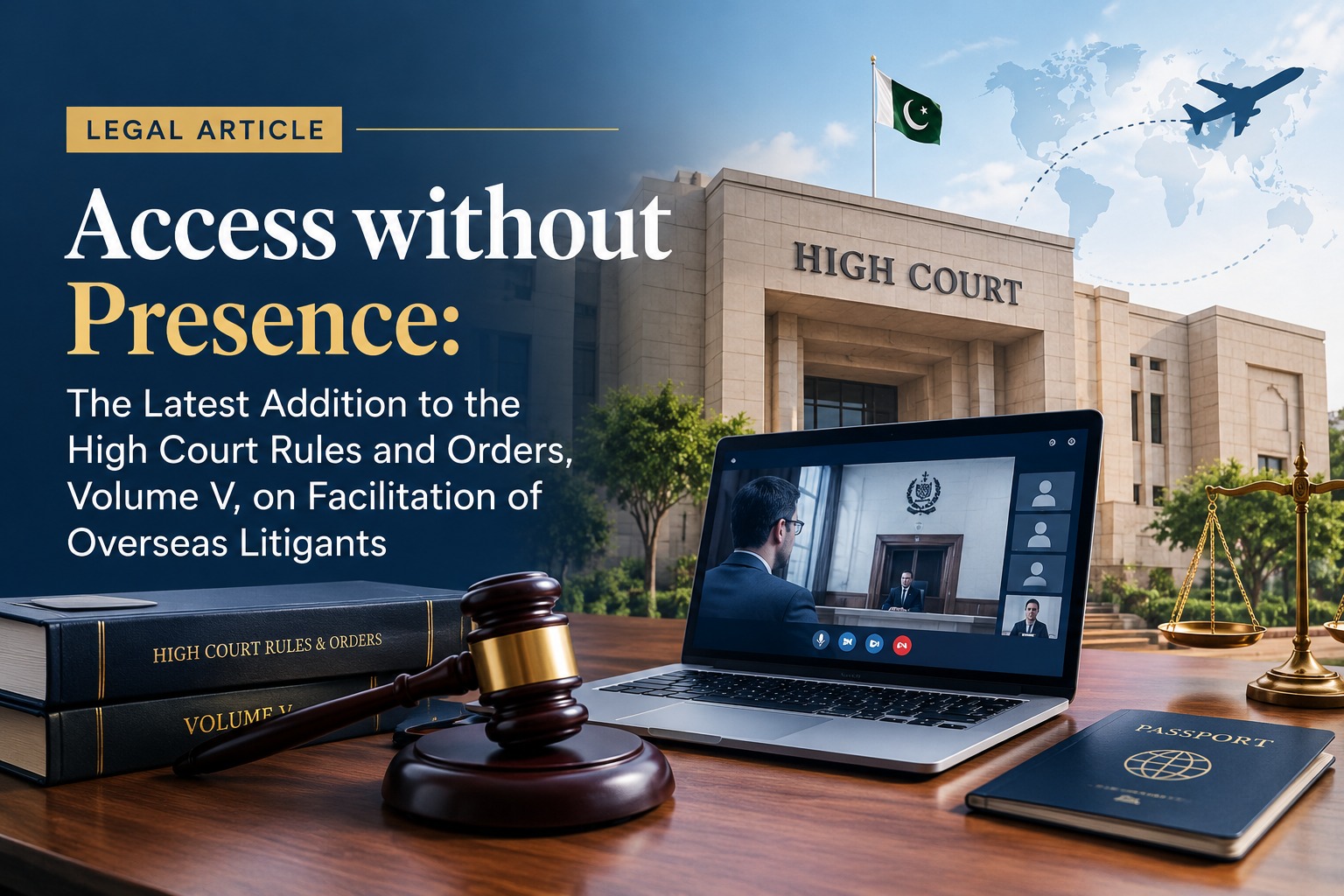
Access without Presence
The Latest Addition to the High Court Rules and Orders, Volume V, on Facilitation of Overseas Litigants
On the E-Filing and Procedure Rules, 2026, notified by the Lahore High Court under the Punjab Establishment of Special Courts (Overseas Pakistanis Property) Act, 2025
The distance between a litigant and the court that must decide his title has, for the overseas Pakistani, long been measured in air tickets, powers of attorney, and years.
On 30 September 2026 the Lahore High Court closed part of that distance by rule. Chief Justice Aalia Neelum caused to be notified, through the Registrar, the E-Filing and Procedure Rules, 2026, framed for the special courts constituted under the Punjab Establishment of Special Courts (Overseas Pakistanis Property) Act, 2025 (Act IX of 2025).
The notification places electronic filing, electronic service, video-link hearing, electronic evidence and digitally certified decrees upon a statutory footing, and directs that the rules be read into the relevant parts of the Rules and Orders of the Lahore High Court. In the architecture of those Rules and Orders, that place is Volume V.
I. Volume V, and why the addition belongs there
Volume V of the Rules and Orders of the Lahore High Court, Lahore, is the volume relating to proceedings in the High Court. It was made in exercise of the rule-making power now resting in Article 202 of the Constitution of the Islamic Republic of Pakistan, 1973, and, in its revised edition, regulates the presentation and reception of appeals, petitions and applications, the preparation of paper-books, the jurisdiction of a Single Judge and of Benches, and — in Chapter 7 — the rules framed under special Acts.
Chapter 7 is the natural repository of procedure made for a forum which the High Court does not itself constitute as a Bench, but which it is charged by statute to regulate.
The 2025 Act does precisely that. Section 5(1) obliges the Lahore High Court to make rules enabling the filing of petitions, responses and applications, the hearing of parties, and the recording of evidence, together with all matters connected therewith or incidental thereto, through digital and electronic means.
The E-Filing and Procedure Rules, 2026, are the discharge of that obligation.
Contemporary reports of the Registrar’s notification describe a fourteen-page instrument, and record that the rules are to be incorporated into the relevant parts of the High Court Rules and Orders.
For the practitioner, the addition is therefore not a free-standing circular. It is subordinate legislation, made under a special Act, and it takes its place in Volume V alongside the other special-Act procedures which that volume has long carried.
II. The parent statute
Act IX of 2025 was passed by the Provincial Assembly of the Punjab on 20 January 2025, assented to by the Governor on 29 January 2025, and published in the Punjab Gazette (Extraordinary) of the same date.
Its preamble states the necessity of special courts:
“to secure and provide for protection of rights of ownership and possession in respect of immovable properties of overseas Pakistanis and for matters connected therewith and incidental thereto.”
The Act authorises the Government, in consultation with the Chief Justice of the Lahore High Court, to establish as many special courts as may be necessary, and to appoint as judge a person who is or has been a District Judge or an Additional District Judge, or an Advocate of the High Court of not less than ten years’ standing, not above sixty-five years of age.
A petition is to contain a concise statement of the ownership and of the unlawful possession or control, the estimated market value, any rent or profits received by the person in unlawful possession, and the relief claimed.
Two provisions are particularly significant
Two provisions of the Act are the direct parents of the Volume V addition.
First, section 5 requires rules for:
- e-filing;
- electronic hearing;
- electronic evidence; and
- a designated account in which court-fee and other charges may be deposited manually or through modern devices, including e-filing, subject to the Punjab Public Financial Management Act, 2022.
Second, the procedural command provides that a special court, on the request of an overseas Pakistani litigant, shall arrange participation by video link; that evidence of an overseas litigant or witness shall be receivable through the concerned High Commission, Embassy or Consulate by video link or other legally acceptable mode, under the supervision of an official notified for the purpose; and that the cause list and short orders shall be uploaded on a web portal established for the purpose.
The scope of that jurisdiction has already been settled by the High Court itself.
In a judgment of May 2026 authored by Justice Anwaar Hussain, the Court held that the special courts are not confined to bare questions of ownership and possession.
Once the dispute relates to immovable property and an overseas Pakistani is a party — whether as petitioner or as respondent — the jurisdiction extends to:
- specific performance;
- partition;
- inheritance;
- validity of transactions;
- mutation;
- powers of attorney; and
- matters ancillary or consequential.
Pending proceedings are to be transferred under section 13 and continued from the stage already reached, so that the litigant is not put to a second trial.
The Rules of 2026 are the machinery by which that widened jurisdiction can actually be invoked from abroad.
III. The scheme of the Rules
1. Electronic institution
Filing is to be made on the portal approved by the Lahore High Court. Petitions, documents, affidavits and the accompanying record may be lodged electronically.
Upon filing, the applicant is to receive an electronic receipt, a filing number, and particulars of payment.
Advocates and parties must register on the portal, access being keyed to an electronic address and to identity particulars. Documents must be acceptable, legible, and in the prescribed format.
Images, audio, video, maps and other material may form part of the electronic record in the manner approved by the Court.
The receipt and filing number are not clerical courtesies.
In a limitation-sensitive jurisdiction they are the contemporary equivalent of the diary number and the court-fee endorsement, and counsel will be well advised to preserve them as the primary proof of institution.
2. Electronic service
Notices may be served by electronic mail, by notification on the portal, or by other approved electronic means, and the record of such service is to form part of the proceedings.
This is a material departure from the presumption, still embedded in large parts of Volume V and of Order V of the Code of Civil Procedure, 1908, that service is an act done upon paper and proved by process-server.
Electronic service will stand or fall on the integrity of the address furnished at registration and on the log of transmission.
A party who registers an address and thereafter neglects it will have difficulty in invoking the equitable jurisdiction to set aside an ex parte order.
3. Hearing without physical presence
Special courts may conduct hearings by video link where the circumstances so warrant, and in particular to secure the participation of the overseas Pakistani.
The Court is to settle the procedure with regard to the presence of parties, the transparency of the proceedings, and the requirements of justice.
The Act’s language is stronger than a mere enabling power: on request, arrangements “shall” be made.
The Rules supply the manner.
Between them, request plus feasibility ought ordinarily to mature into a direction, and a refusal should be a speaking order.
4. Evidence, record and decree
The Court may receive and evaluate evidence tendered electronically, including material which is not a traditional document.
Proceedings are to be recorded and the electronic record preserved.
Judgments, decrees and other material orders are to be uploaded to the portal.
In the circumstances prescribed, an electronically uploaded decision is to be treated as an official copy, and the Rules provide for the execution and verification of digitally certified copies.
Security, storage, privacy, restricted access to sensitive judicial information, and backup are expressly addressed, access being limited in accordance with law and the policy of the High Court.
5. The paper fallback
Physical filing remains available where e-filing is not practicable, for reasons recorded, and an alternative mode is provided where the portal is disrupted.
The addition is therefore not a closed digital system.
It is a digital system with a safety valve, which is the only form of digital procedure compatible with Article 10-A.
IV. Constitutional and evidentiary footing
Article 10-A guarantees a fair trial and due process.
For a litigant resident abroad, fairness is not exhausted by a theoretical right of audience in Lahore. It includes a real opportunity to institute, to be served, to be heard, and to test the evidence, without the proceeding being decided in his absence for want of means to attend.
Article 4 requires that a person be dealt with in accordance with law. The Rules are the law by which that dealing is now to occur in this class of case.
Electronic evidence does not stand outside the Qanun-e-Shahadat Order, 1984.
Articles 46-A, 78-A and 164, read with the Electronic Transactions Ordinance, 2002, already admit electronic and automated information and preserve the Court’s power to receive evidence which has become available because of modern devices, where the interest of justice so requires.
What the Rules add is not a new theory of proof but a channel:
identity of the deponent, integrity of the file, and supervision of the overseas examination.
The statutory requirement that evidence from abroad be recorded under the supervision of a notified official of the High Commission, Embassy or Consulate is the safeguard which keeps video-link testimony from collapsing into an unsworn statement made in a private room.
The oath remains an oath under the Oaths Act, 1873; only the place of its administration has moved.
A digitally certified copy which the Rules designate as an official copy ought, in execution and in collateral proceedings, to be received as a certified copy within the meaning of the relevant provisions of the Qanun-e-Shahadat and of the Code, subject always to proof of the digital certification where it is disputed.
Counsel relying on such a copy should carry the verification particulars the Rules prescribe, rather than assume that every printout from the portal is self-proving.
V. What the addition does, and does not, change
The addition does not enlarge the subject-matter jurisdiction of the special courts.
That jurisdiction is the Act’s, as construed by the High Court in May 2026.
Nor does it displace the Code of Civil Procedure where the Act and the Rules are silent.
It changes the mode of invocation and of participation.
Four practical consequences follow
1. Institution from abroad
Institution from abroad is no longer dependent on a local attorney merely to cross the registry counter, though a duly appointed advocate remains necessary for representation, and a vakalatnama or authority executed abroad will still require the attestation the Rules accept.
2. Electronic service
Service, once an electronic address is on the record, can no longer be treated as a matter of months. Delay in a special-court petition will have to be explained by something other than the absence of the petitioner from Pakistan.
3. Video-link participation
An application for video-link participation should be made at the earliest stage, identifying the High Commission, Embassy or Consulate through which evidence is proposed to be recorded, so that the notified official can be arranged before the date of hearing.
4. Pending proceedings
Where a pending civil suit has been, or ought to be, transferred under section 13, the electronic record should be built from the stage already reached.
The Rules are a facility, not a warrant to reopen evidence already recorded.
The addition is also court-specific
It regulates the special courts under the Punjab Act.
It is not a general licence for video-link appearance in every writ petition or regular first appeal pending in the High Court, although Volume V already coexists with the High Court’s separate video-link arrangements for district courts, under which overseas witnesses may join through a mission of Pakistan.
Those arrangements and these Rules should not be conflated.
One is a case-management facility; the other is procedure prescribed by statute for a designated forum.
VI. A note on the wider landscape
The Lahore addition does not stand alone.
In September 2025 the Supreme Court established an Overseas Litigants Facilitation Cell for matters within its own appellate jurisdiction, reachable through a dedicated channel and the Court’s portal, confined to that jurisdiction.
In March 2026 the Islamabad High Court notified rules under the federal statute on special courts for overseas Pakistanis’ property, including acceptance of specified alternatives for notarisation and attestation of vakalatnamas and affidavits executed abroad.
The Punjab Rules of September 2026 are the corresponding, and for the Lahore practitioner the immediately operative, instrument.
Their incorporation into Volume V gives them a durability that a press note does not.
VII. Conclusion
The latest addition to Volume V is a modest instrument with a large consequence.
It does not promise a judgment.
It promises that the overseas litigant can reach the court which the Provincial Assembly created for him, without first purchasing a presence he cannot afford to maintain.
Institution, service, hearing, evidence and decree are each given an electronic form, a paper fallback, and a place in the Rules and Orders by which the High Court has for generations regulated its own proceedings and the proceedings it is charged to supervise.
For counsel, the discipline is ordinary and exacting.
Register the address with care, because service will follow it.
Preserve the electronic receipt, because limitation will be reckoned from it.
Ask for the video link in time, and name the mission through which the witness will be sworn.
Treat the uploaded decree as an official copy only in the circumstances and with the certification the Rules prescribe.
And read the addition as what it is: a chapter of Volume V, made under section 5 of Act IX of 2025, in aid of a jurisdiction the High Court has already held to be wide, and in discharge of a constitutional duty which Article 10-A states in a single sentence and which distance has too often defeated.
Note on sources
This article is drawn from the Punjab Establishment of Special Courts (Overseas Pakistanis Property) Act, 2025 (Act IX of 2025); the scheme of the E-Filing and Procedure Rules, 2026, as notified by the Registrar of the Lahore High Court on 30 September 2026 and reported on 30 September and 1 October 2026, including the direction that the rules be incorporated into the relevant parts of the Rules and Orders of the Lahore High Court; the judgment of the Lahore High Court of May 2026 (Justice Anwaar Hussain) on the scope of the special courts; Volume V of the Rules and Orders of the Lahore High Court (revised edition), relating to proceedings in the High Court and, in Chapter 7, to rules under special Acts; and Articles 4, 10-A and 202 of the Constitution.
The numbered text of the fourteen-page rules, once gazetted, should be preferred on any point of detail.